

Beyond the ledger: Accounting and value creation in the age of AI
The disruption facing accounting isn’t coming – it’s already here, and finance professionals must evolve from recorders of data to creators of value
“Some people have said to me, ‘Look, AI is going to fundamentally change accounting.’ They’re wrong. It’s already changed it.” That’s the perspective of Michael Ford, Founding Partner of Equilibrium Group, a firm that provides advisory and consulting services in strategy, business development, finance, transformation and investor relations. AI and other rapid technological changes, in particular, have created huge opportunities for those who embrace them.
In a world where AI can generate reports in seconds and automate tasks that once consumed entire teams, what role will accountants play in creating value for organisations? In delivering the 2025 Bill Birkett Memorial Lecture, presented by the UNSW School of Accounting, Auditing and Taxation, in partnership with CPA Australia, Mr Ford shared perspectives shaped by 30 years working inside some of Australia’s largest corporations and consulting with CEOs across industries.
As the former CFO of News Corp Australia, QBE Insurance and the Deputy CFO of Commonwealth Bank, he has navigated technology revolutions before. His current work includes advising CEOs, Boards, and Leadership teams, designing and delivering digital education for global financial groups, and coaching senior executives. This experience has provided him with deep insights into what drives value creation today and how organisations are responding to the latest wave of change driven by AI.
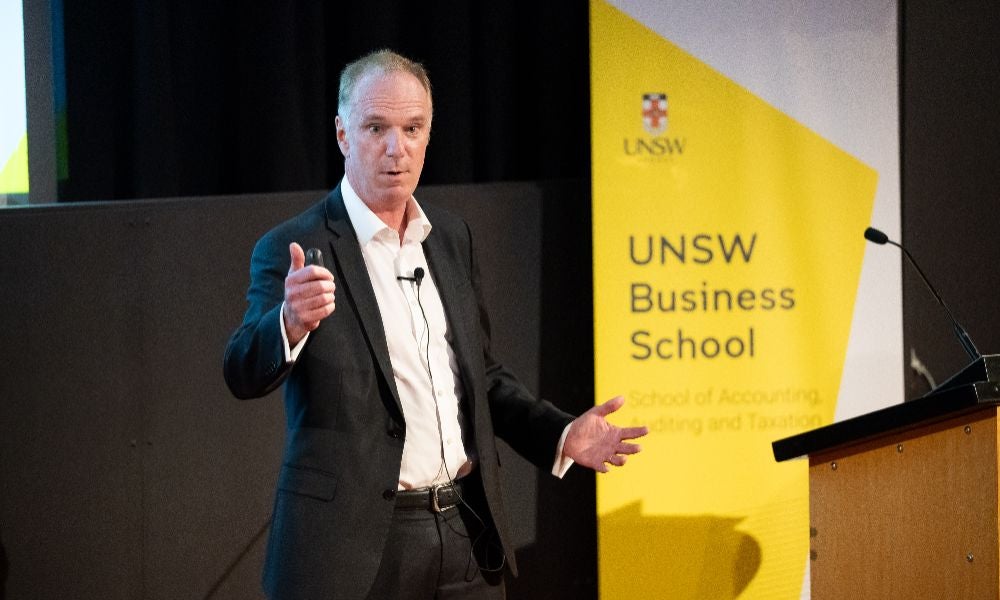
The accounting profession faces a moment that Mr Ford compared to the early days of mobile phones. He reminded the audience that the first mobile phones looked like car batteries. People laughed at the idea of needing to make calls while away from a desk. However, the world changed faster than anyone anticipated. Mr Ford observed that organisations and professions that stood still during transition struggled to catch up or disappeared entirely. Australian corporates are moving at varying speeds, and the organisations that take a structured approach to rolling out AI across the value chain and embracing the opportunity will win.
“For professions, whatever they are, if they stand still, they’re toast,” said Mr Ford. “Medicine, engineering, banking, and building are all embracing change. Finance and accounting are the same – my goodness, for all professions, it’s always time to evolve and change, or there won’t be such a thing. You’ve got to embrace it, grab it, and go for it.”
Mr Ford was very optimistic about the potential of technologies such as AI, which he saw as an opportunity for liberation rather than a threat. AI and automation can free finance professionals from tasks that consume time without creating value, allowing them to focus on what he called the real work: partnering with CEOs, driving strategy, understanding customers, and making decisions about where organisations invest resources.
Subscribe to BusinessThink for the latest research, analysis and insights from UNSW Business School
He explained how accountants and finance professionals can position themselves as creators of value rather than recorders of history. His framework focused on areas where the profession can drive impact: customer focus, analysis through different lenses, resource allocation, technology adoption, and maintaining trust in an automated world.
The customer imperative: Where value creation begins
Ford emphasised that value creation starts with understanding who benefits from an organisation’s work. He broke this down into three groups: customers, shareholders, and the community, which includes employees, suppliers, and regulators. Each group has expectations that organisations must meet, and the tension between these demands requires navigation.
“Every business starts with its customers. Value creation can take many forms. For customers, it’s basically delivering value, building long-term loyalty, delivering products or services to them,” he said. “So, it’s very important, and there’s social value as well as the values of the actual product.”
Organisations that excel at value creation embed customer focus into every role and decision. Many companies proclaim they will be customer-centric when a new CEO takes charge, but he observed that few follow through. Revenue drives growth, and revenue comes from customers, which means finance professionals must understand customer segments, product margins, capital allocation, and market dynamics. The opportunities using AI to enhance customer experience, improve efficiency and simplify are incredible. Ultimately, it's important that Australian businesses move quickly to continue building market-leading, competitive businesses for the future.
Photo gallery: The 2025 Bill Birkett Memorial Lecture
The 2025 Bill Birkett Memorial Lecture. Photos: Stanley Images
Mr Ford shared an example of reviewing weekly reporting for one of Australia’s largest corporates, where customer-focused metrics were absent. “I remember walking into one of Australia’s largest corporates not that long ago. ‘Can you have a look at all the weekly reporting that goes up to the exec team?’” he asked. “Yeah, no problem. I’ll have a look,” was the response. Mr Ford’s first observation was that there was very little customer observation, with a very quick, basic analysis.
He also recalled technology entrepreneurs who approached him with products they described with enthusiasm. When he asked about their path to market, they had no answer. Years later, these individuals remained stuck at the startup stage because they had not identified their customers or understood the market dynamics that would drive value creation.
Looking through lenses: The art of analysis
Mr Ford challenged the audience to rethink management reporting. He described much of the reporting he encounters as following patterns that fail to drive decisions or create value. Finance professionals have access to data first, but he noted that just serving up the same reports month after month does not help organisations move forward.
He drew on the analogy of taking a family to a restaurant, and most family members will order exactly what they had on the previous visit. Instead, Mr Ford suggested asking the restaurant to bring what they think the customer will like.
Mr Ford also attends a gym regularly and recently signed up for a pre-Christmas ‘big sprint’ to challenge himself. “Sign up to work harder, where you have a personal trainer hustling you,” said Mr Ford, who explained how a personal trainer asks new questions that provoke thinking and challenge assumptions.
Learn more: Six tips for accounting professionals to excel in a world with ChatGPT
“This is what finance professionals should do with the data they control,” he said. Information needs to be viewed through different lenses constantly. Early in his career, for example, one CEO with whom Mr Ford worked demanded that he challenge the management team during their sessions by presenting information and analysis through different lenses. Strong analysis using forward-looking perspectives was key to attending the meeting, far more important than recurring management reporting.
Mr Ford also said, “What gets measured gets done,” but measuring too much can create paralysis and a lack of focus. He explained how he encountered one CEO whose management metrics all showed green. However, a closer analysis revealed that the core business was shrinking while ventures grew, and Mr Ford explained that the organisation was looking at the wrong information each month.
Resource allocation: Flipping the triangle
During the lecture, Mr Ford introduced a concept that can help challenge how finance teams allocate their time. He described a pyramid with three layers. At the bottom sits the production and recording of data. The middle layer contains performance analysis and reporting. The top represents insights and questions about where to invest and how to create value.
Most organisations concentrate resources at the bottom of the pyramid; however, Mr Ford argued that organisations should flip the triangle entirely. “Automate the bottom layer, streamline the middle, and focus resources on the top where value gets created,” he said.
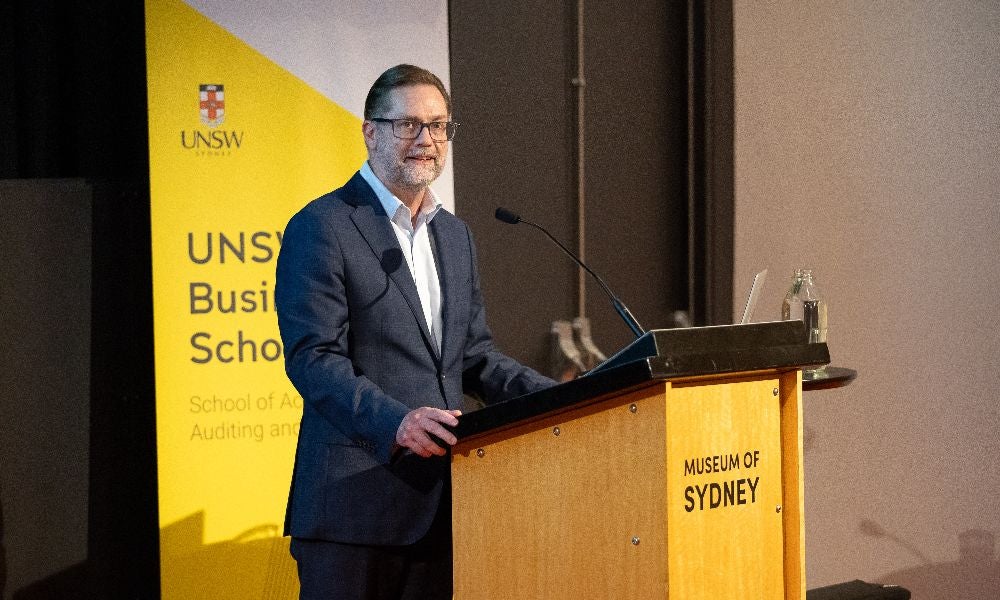
The shift might raise concerns about job losses, but Mr Ford dismissed this as thinking that misses the point. If organisations embrace technology and become more competitive, they will create more opportunities. Standing still in the name of protecting roles will make organisations less competitive and slow down progress.
Mr Ford pointed to integrated reporting as an example. For organisations with purpose and measurement systems, updating the actual integrated report should be very quick with AI enablement. The reporting is purely an output that should be simplified, and the finance team should be more focused on the true value-creation opportunities, substance, and measures that drive the organisation forward.
The technology revolution: AI has changed everything
Mr Ford stated that AI has already changed accounting, though many organisations move slowly to recognise this reality. The tools exist, the platforms are available, and organisations globally have embedded these capabilities into their systems. Analytics, benchmarking, and processing can all be automated, but he said implementation requires governance and skill development.
“Some people have said to me, ‘Look, AI is going to fundamentally change accounting.’ They’re wrong. It’s already changed it,” he said. “It’s just that a lot of Australian businesses are actually quite slow to pick up on this, and a lot of businesses aren’t embracing it as quickly as the opportunity that’s there.”
He described organisations that roll out Microsoft’s Copilot to all employees to enable experimentation. This approach, Mr Ford suggested, resembles handing calculators to people who do not know mathematics. This is one basic step, however, to genuinely realise the huge opportunities, he said the process needs structure, governance, capability building and follow-through. Moving quickly to get this right is creating a significant competitive advantage in the companies Mr Ford has worked with.
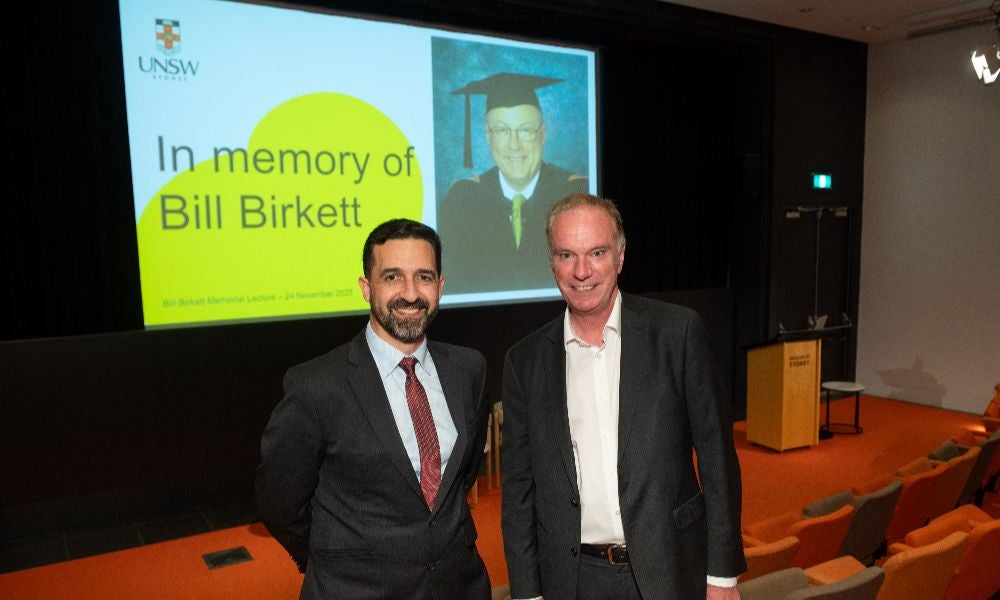
Mr Ford shared a simple example that illustrated the pace of change. One organisation he worked with needed to quickly produce a marketing video, but received expensive quotes to deliver it. Instead, the organisation’s CEO completed the work herself in 45 minutes to demonstrate the technology’s capabilities and the need for her team to move rapidly to adopt it.
Another approach Mr Ford referred to is disrupting your own business by embracing available technology and building new platforms. In industries such as parts of financial services and media (in which Mr Ford worked for years), true disruption comes from building new platforms, which can be faster and easier than fixing existing systems.
Trust and integrity: Maintaining standards in a world of technology
While technology is reshaping the world of accounting, Mr Ford affirmed that it cannot replace the elements that drive value creation. Finance professionals are advisors and custodians of data integrity, and in a world of change, he said, data governance becomes more critical, not less.
“As I said, technology is really, really important, and you’ve got to embrace it. Final point: communication, trust, integrity – these are critical. For finance and accounting professionals, they are the trusted advisor,” said Mr Ford, who explained that it is critical to maintain data that can be trusted, keep reporting simple, and ensure oversight and good governance as technology handles more tasks.
Learn more: Can accounting fix global climate disclosure challenges?
Mr Ford acknowledged that his message might challenge some in the audience, as value creation focuses on the future rather than the past, which means professional roles will change rapidly in the coming years.
Embracing learning to prepare for the future
Mr Ford closed by emphasising that the finance and accounting skills he learned at UNSW Business School have served him throughout his career. The skills have provided a framework for understanding business drivers and creating value. Mr Ford has then pursued extensive further education in technology, business, and leadership, and he emphasised the importance of all graduates continuing their education and investing in development. Strong technology skills, in particular, are critical.
“So fundamentally, these skills are of great value. But the world’s really changing. It’s changing rapidly,” he said. Mr Ford said professionals should not expect their roles to exist at all as they currently do in, say, 10 years. If roles remain unchanged, he said Australia risks remaining uncompetitive. Rather, the organisations that perform well share common traits: people know their customers, adapt to serve them, and evolve their roles without waiting to be told.
Learn more: Three ways data analytics will change the future of accounting
As such, Mr Ford challenged the profession to consider how it positions itself in a world that continues to change. While reporting requirements exist, he said compliance-related tasks alone will not grow organisations or create value. Instead, CFOs must remain at the table, leveraging their accounting skills, but the profession must embrace change to maintain relevance.
When asked to predict what topic might dominate the Bill Birkett Memorial Lecture in 2035, Mr Ford expressed hope that the conversation would not centre on reporting and metrics. Instead, he looked forward to a future that would celebrate the impact the profession has had in building a stronger Australia and growing organisations through value creation. “I hope they’re talking with real substance about how CFOs, their teams and accountants and everyone are adding value in different scenarios,” he concluded.